Ferrying 101: Getting from Port to Port to Destination
By CraftyWanderer | August 27, 2025
Indonesia is the largest country on earth that consists only of islands. Estimates vary, ranging from 13,000 to a mind-boggling 25,000. The Indonesian Coordinating Ministry for Maritime Affairs put it at 17,508, which was the most cited figure in 2021 according to Andréfouët et al. (2021). No wonder then that taking the ferry is such a popular method of transport, for locals and tourists. In this blog I will give you all the ins and outs to get from port to port (to destination) yourself!

Children playing football on Kusamba beach at the port terminal, Bali.
Image © by Ilse Ronner
Buying your ticket online
The easiest way in my experience to get tickets is to book them online. There’s many different websites and apps that you can use, but the one I had personal good experiences with was 12go.asia. What I like about this website is that it compares different ferry companies, much like sites like Skyscanner do for airplanes. You can filter using different parameters, look at reviews, and often even photos of the inside of the ferry.
Additionally, you can see different ports (unless you enter that you want to depart at a specific one). This was a bit of searching, as you do need to enter them manually in Google Maps or another mapping service. Especially on Bali, booking tickets to go to Nusa Penida, it took a minute to find a terminal that wasn’t too far away from where I was staying with my friend. Do be prepared in Bali that you might need to travel for one to two hours if your accommodation is in the Kuta area or around Denpasar Airport.
Once you have booked your tickets, make sure to download the e-ticket (unless you have mobile data, but then it is still wise to just have them downloaded and ready) and plan your transport with a buffer. More on that below. Some ports consist of a building with different check-in desks and have a system for large luggage. For example, on Nusa Penida we had to check our big luggage so the personnel could transport it onto the boat. Other ports are not much more than a small check-in cubicle with a roofed terrace as you wait for the departure of your boat. I will share some experiences about this below as well.
Getting your ticket at the port
Of course it is also possible to buy your ticket at the port itself. Generally, there will be a ticket office either in the port building or (if there is no building) before you enter the waiting area. I personally wouldn’t recommend this, as there is no way to compare prices unless the port is big enough to shop around at different operators, nor do you have an option to check reviews. From a planning point-of-view I also like to know what departure times are available before travelling to the port with all my luggage so I can sort-of plan my activities around it. Sort-of, for I have learned to plan a healthy buffer around transport services in case of any delays.
From A to port, from port to B
Besides getting a ticket to travel from port to port, you also need to get to and from those locations. On Java and Bali (where I have personally been) you can get around with Bluebird Taxi’s, Gojek and Grab. Bluebird is an official metered taxi service that has come out slightly cheaper sometimes than Gojek and Grab. Especially when there is a high demand for services.
Depending on the island, there are also buses available and trains. The trains on Java I have had very good experiences with, always departing and arriving on time. For buses I cannot speak, but knowing the traffic in Indonesia, I would for sure plan a sufficient buffer if you choose this option.
On Nusa Penida, there is no Grab, Gojek or Bluebird available. This for sure was a surprise for us when we arrived there in the afternoon and had to haggle for a good price (spoiler: we still paid too much). On Lombok these services are very limited, being only available in the areas of Mataram, Senggigi and around the airport. To spare yourself the hassle of having to negotiate for a taxi and likely paying more than you should, you can just ask your accommodation to arrange a taxi for you instead.
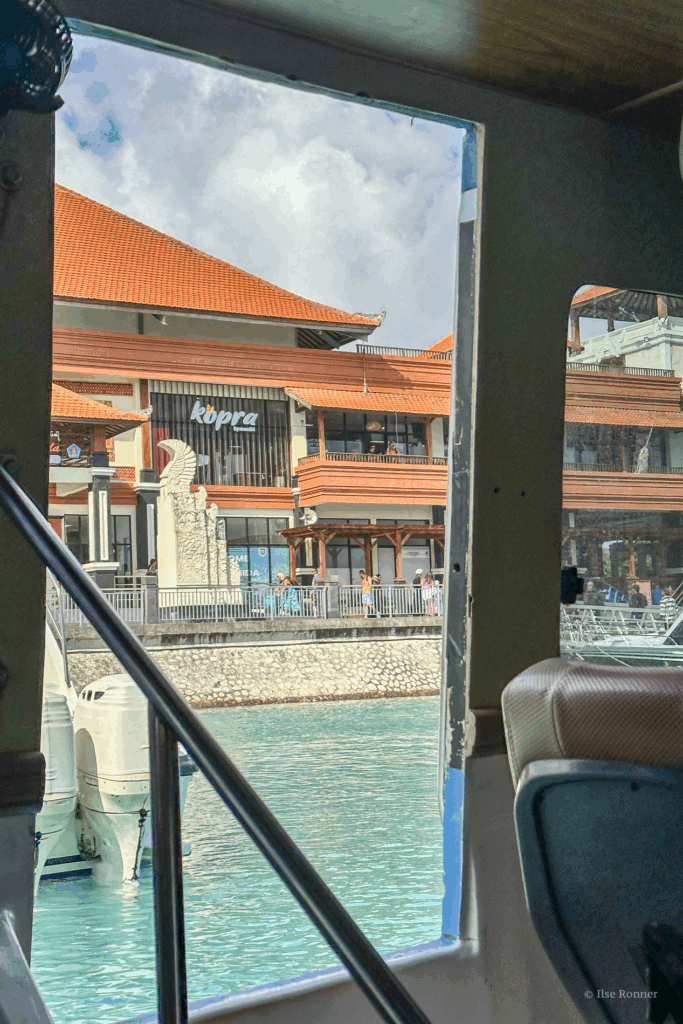
View of Sampalam Port, Nusa Pennida
Image © by Ilse Ronner
Our experience at Sampalam Port
I have both departed from smaller ferry terminals with no terminal building (except for a small cubicle the ticket sellers were staying in), and bigger terminals with dedicated check-in desks. As I believe every terminal has its own slight oddities, I think it’s nice to share about my own experiences. Starting with those at Sampalam Port on Nusa Penida, which was most memorable by far. Arriving in the terminal building, check-in seemed smooth at first. We dropped off our big backpacks after ensuring they got tagged to be taken to the correct port, and walked upstairs to the waiting area. Here, I took time to check our ticket, discovering something curious, for the tickets were addressed to people with different names than ours, using a ferry operator different to the one we booked.
Language barriers aside, we were reassured that this ferry would for sure take us to Lombok at about the same departure time. In the waiting area, however, there were two points where people could go from where the ferry would depart. Initially, we were sent to the wrong section, of which we discovered the error by signalling that there were fellow tourists waiting in both areas. All were wearing the same blue keychains, which makes identification easy if you are ever unsure where to board exactly. They give you keychains at every port so they know you are boarding the correct ferry and have bought a ticket, before getting onto the boat, you hand them back over.
Some more Google Translate-assisted talking later, and all tourists were corralled onto the ferry. It was indeed a different one to the one we booked, but this one was slightly more luxurious and mostly empty which makes me guess that they were just combining all travellers to the Gili Islands and Lombok onto the same boat. Thankfully, the sailing was just as smooth as our ferry from Bali to Nusa, and we got some funny travel memories to boot.
Don’t let this story discourage you however, for the ferry is a fantastic, budget friendly way to get around Indonesia. With Google Translate (or any other translation app) as backup, you will find most Indonesian people are more than happy to help you figure out where to go. Everyone is so nice and kind, that if you are not in a rush, you will definitely get on that ferry to the correct destination!
Sources
Andréfouët, S., Paul, M., & Farhan, A.R. (2021). Indonesia’s 13558 islands: A new census from space and a first step towards a One Map for Small Islands Policy. Marine Policy, 135, 104848. doi:10.1016/j.marpol.2021.104848
No responses yet